Fuse #1: Did I steal it?
After building the first version of Palette, I had to show it to people, of course. Reactions ranged from “I am colorblind and this is my nightmare,” to nothing at all (I was probably ignored), to “this is fun but weirdly frustrating.”
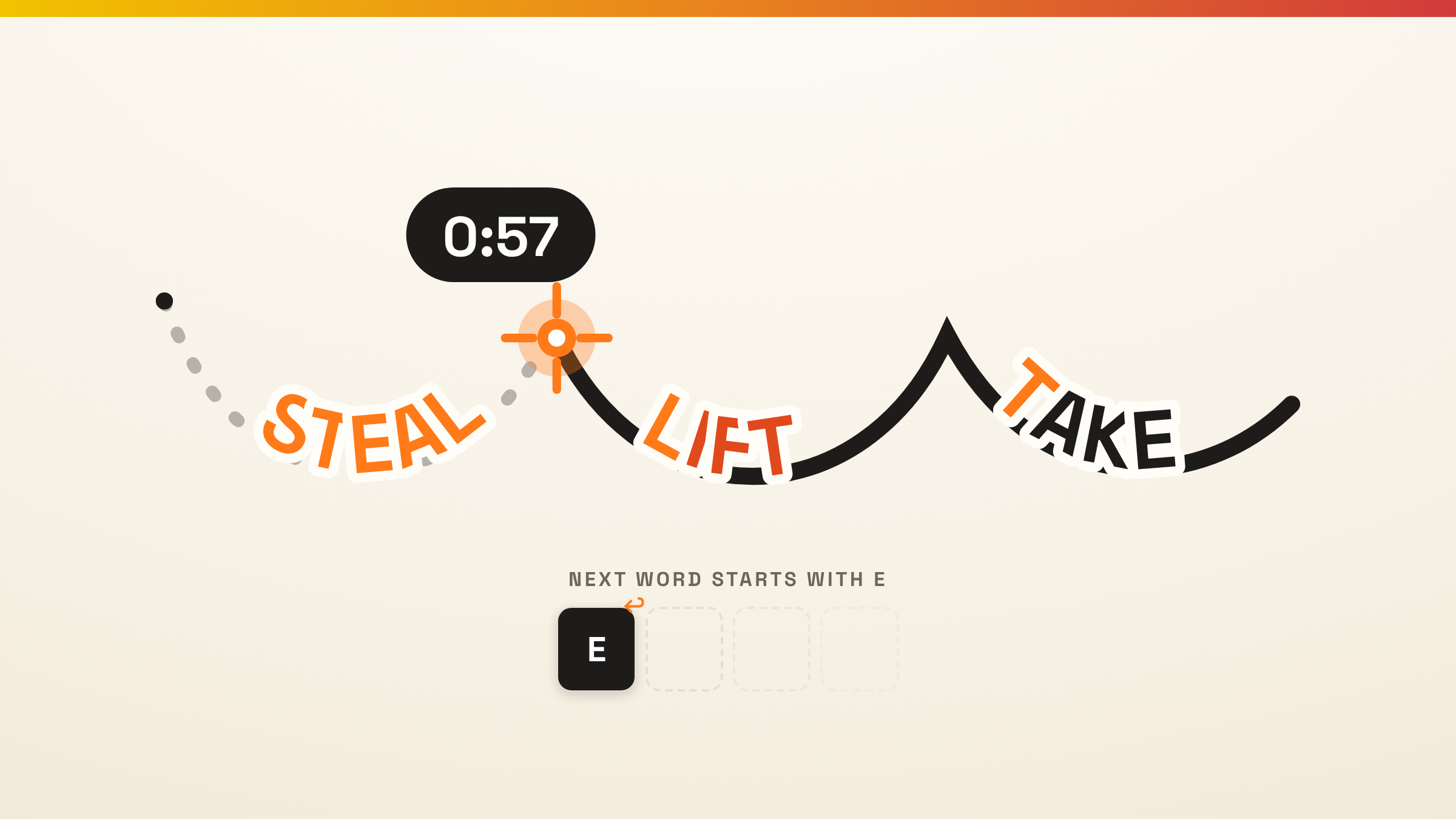
The response that led to this post was a text from a friend. As best I remember it: “I have had an idea for a game, [and / but] you [can / can’t] steal it.” The idea was a chain of words, where each word begins with the last letter of the word before it.
I was eating dinner with my family at the time, but I thought, I can build this. So I started pulling the thread.
To work as a daily game, a word game like this needs to be deterministic. Luck cannot decide your score, or what would anyone be comparing? I pictured games like Scrabble or Bananagrams, with a bag of tiles you draw from. To be deterministic, those tiles need a set order, and that order has to be the same for every player, so the same plays always give the same results.
With the starting order set, that left how tiles get reused. Here is how it plays. You hold seven tiles. Each word must start with the last letter of the word before it, and that letter is free, so you add one to seven tiles from your hand to make a word of two to eight letters, then draw from the deck to refill.
The chain holds three words. Each new word pushes the oldest one off, and its tiles explode back onto the bottom of the deck in the order they were played. So the deck is not only fixed, the tiles recycle. Same plays, same game for everyone each day.
The explosions made me think about time as a core mechanic. A clock is always running, and every word you enter buys back time. Each word must also be unique, and this creates a natural tension as you try and find new words.
I built it under the same constraints as Palette, and with the basic mechanic in mind, the next step was to playtest. The first few rounds taught me two things right away. I needed a way to swap tiles when I got stuck, and ending a word on a letter like K is a risky choice.
The issue is the imbalance between the words that end with a letter and the words that begin with it. K and E are the two I learned to be most careful with. Plenty of words end in K or E, but far fewer begin with them. Every time I went to submit a word, I had to weigh that, in natural tension with the ticking clock.
Next were the knobs for scoring and difficulty.
Scoring started out more or less obvious. I made a table of how many points each word length is worth and how much time it adds to the clock. Then came the bonuses. After considering different options, what I landed on was one each time you make a word of a length you have not made yet, one each time a word explodes back into the deck, and one that would later turn out to be the key balancing mechanic. That last one is a streak bonus for consecutive words of the same length. Each word in a streak earns 2 more than the one before, so the bonus totals 2, 6, 12, 20, and on: the triangle numbers, doubled.
Difficulty lives mostly in the deck. Because each day’s tiles and their order are locked, I can check every puzzle in advance and ensure there are good paths through the first few words. The same check looks at how the vowels and consonants mix, how often uncommon letters like X or Q show up, and which letters are painful to end a word on.
The other knob was the seed word, the word each day’s chain starts from. It is the first link in the chain, it is the first to explode and recycle its tiles, and it sets what letter your first word starts with. BLACK, ending in K, is a good example. The very first one was NOXIOUS, a nod to nox.black, and you can still play it here:
Across the week, difficulty follows the same curve as Palette, easy on Monday and hardest by Saturday, but here the dials are the deck’s size, its mix of letters, and the seed word. The generator also arranges the seven tiles in your opening hand. On Monday, a long word sits there in order, ready to read straight across. From Wednesday on, nothing longer than three letters does. The week looks like this:
- Monday: The biggest deck, rich in vowels, with a five-letter word waiting in order in your hand.
- Tuesday: The same easy deck, but no word over five letters reads straight across.
- Wednesday: A tighter deck with fewer vowels, and nothing over three letters in order.
- Thursday: As few as three ways to open, and more of the awkward letters like J, Q, X and Z.
- Friday: The smallest deck and the fewest vowels. Any three-letter word in order is an obscure one.
- Saturday: Friday’s rules, with the rudest seed words (it also probably varies more in Tråd, but that is another article).
- Sunday: Wednesday’s deck again, a breather after the two hardest days.
Finally, the name, and this time it was pretty obvious. FUSE: you fuse words together into a chain. A fuse also burns down, like the clock you are racing, and it ends in an explosion, like every word that blows back into the deck.
In playing each day, the main thing I have learned is that the strategy for points centers on long runs of three-letter words, to push the streak bonus as high as it will go. If I were designing a competitive game, I might cap how large the bonus can get on puzzles after a certain date, or have a swap reset the streak. For a game meant to be played for a minute or two a day, I think this is fine.
The Fuse you play today also looks quite different from the first version. That came from a mockup the same friend sent me, but that is a future story.
Which brings me back to the question I buried at the start. Did that text say I can steal it, or that I cannot? I am honestly not sure, and I am a little afraid to look.